
Indoor air quality is influenced by much more than dust, humidity, mold, or visible pollutants. A home or commercial building can look clean and well-maintained while still containing chemical compounds in the air that cannot be seen. One important group of indoor air contaminants is volatile organic compounds, or VOCs.
VOCs are chemicals that can become airborne under normal indoor conditions. They may come from paints and coatings, adhesives, cleaning products, personal-care products, solvents, fuels, building materials, fragrances, and many other everyday products. Because many VOC sources are invisible, professional VOC testing can provide information that a visual inspection alone cannot.
A recent indoor air quality report illustrates why understanding VOCs requires more than simply asking whether chemicals are present. The report identified a range of individual compounds and potential source categories, including coatings, personal-care products, gasoline, alcohol products, PVC cement, solvents, and other materials. The sample also had a reported total volatile organic compound (TVOC) concentration of 3,500 ng/L.
At Quest Environmental Testing, we provide independent environmental testing to help property owners, occupants, and other clients better understand potential indoor environmental concerns. VOC testing can be an important tool when chemical odors, renovations, new materials, or other indoor air quality concerns raise questions about what may be present in the air.
What Are VOCs?
Volatile organic compounds are chemical compounds that can evaporate or off-gas into the air. Indoors, VOCs may originate from both building-related materials and products brought into a property by occupants.
Potential sources include paints, varnishes, sealants, adhesives, cleaning products, personal-care products, solvents, fuels, fragrances, and certain construction materials.
One of the challenges with VOCs is that there is no single source. Different compounds can point toward different potential sources. For example, acetone may be associated with nail-care products, cleaners, paints, coatings, strippers, thinners, PVC cleaners, caulks, adhesives, and other solvents.
Other compounds may have similarly broad source profiles. This is why identifying individual VOC compounds can provide useful information when investigating indoor air quality.
Read More: Mold Exposure and Allergies: Symptoms, Sensitivity, and Indoor Dampness
Why TVOC Testing Matters
A VOC assessment may include a measurement known as Total Volatile Organic Compounds (TVOC). TVOC provides an overall indicator of the concentration of VOCs detected in an air sample.
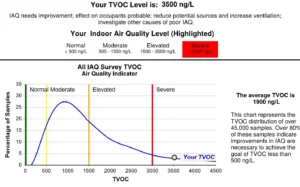
In the report reviewed for this article, the living-room sample had a TVOC level of 3,500 ng/L, which the report classified as Severe under the IAQ Home Survey methodology. The report also explains that these severity classifications are not a pass/fail determination and should not be interpreted as compliance with a government-mandated indoor air limit.
The report references a recommended TVOC goal of less than 500 ng/L from the U.S. Green Building Council and notes that concentrations above 1,500 ng/L indicate that indoor air quality should be improved under its methodology.
This distinction is important. A TVOC number is not a diagnosis and does not automatically identify the source of the chemicals. Instead, it provides an overall measurement that can indicate that further investigation may be appropriate.
Looking Beyond the TVOC Number
One of the most useful aspects of VOC testing is the ability to examine individual chemical compounds.
The report identified several compounds in the sampled indoor air. These included acetone, butane, ethanol, isopropanol, dipropylene glycol methyl ether, toluene, methyl methacrylate, propylene glycol, cyclohexanone, limonene, 1-butanol, n-butyl acetate, xylene, methyl ethyl ketone, alpha-pinene, ethyl acetate, tetrahydrofuran, styrene, chloroform, and naphthalene.
Each compound has different potential sources.
For example, the report measured toluene at 17 ppb and associated it with potential sources such as gasoline, adhesives, contact cement, solvents, and heavy-duty cleaners.
Methyl methacrylate was reported at 14 ppb, with potential sources including acrylic polymers, paints and coatings, adhesives, fillers, solvents, pharmaceuticals, and personal-care products.
Limonene was reported at 5 ppb and may be associated with fragrances, paints and coatings, cleaners, solvents, and preservatives.
These examples demonstrate why compound-specific information can be valuable. A high-level TVOC result can tell you that VOCs are present, while individual compounds can provide additional clues about possible sources.
VOCs From Paints, Coatings, and Renovation
Building materials are an important consideration when evaluating indoor VOCs.
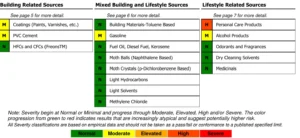
The report’s Contamination Index estimated 840 ng/L from coatings such as paints and varnishes, classified as Moderate. The report notes that this category can include paints, varnishes, lacquers, sealants, and other coating products. It also explains that VOCs associated with these products can remain in indoor environments for months or longer depending on the circumstances.
Renovation and construction activities can introduce numerous potential VOC sources at the same time. Painting, installing flooring, applying adhesives, using sealants, installing cabinetry, and using solvents can all introduce chemicals into indoor air.
This is one reason VOC testing may be worth considering after significant renovation or when chemical odors persist after construction activities have been completed.
Everyday Household Products Can Also Affect Indoor Air
VOCs are not limited to construction materials.
One particularly notable category in the report was Personal Care Products, which had an estimated VOC level of 1,200 ng/L and was classified as High under the report’s Contamination Index methodology.
The category includes products such as soaps, deodorants, lotions, perfumes, hair-coloring supplies, nail-care products, and oral-hygiene products.
The report also identified Alcohol Products at 230 ng/L, classified as Moderate. This category can include household cleaning products, antiseptic wipes, hand sanitizers, some solvents, reed diffusers, alcohol-containing products, and certain pharmaceuticals.
These findings illustrate an important point: indoor VOC sources can come from ordinary activities and products, not just major industrial or construction-related sources.
Gasoline, Solvents, and Other Chemical Sources
The report also identified several categories associated with fuels and solvents.
Gasoline was estimated at 320 ng/L and classified as Moderate. Potential sources described in the report include gasoline containers and gas-powered equipment stored in attached garages or basements, as well as previous spills that may have affected flooring.
The report also identified light solvents at 170 ng/L and described potential sources such as mineral spirits, paints, varnishes, enamels, wax removers, adhesives, automotive products, and light oils.
This demonstrates why VOC investigations sometimes require consideration of the entire property. A source may not necessarily be located in the room where the air sample was collected. Products stored elsewhere in a building can potentially contribute to indoor air contamination depending on ventilation, airflow, storage conditions, and other factors.
Some VOCs Are Associated With Hazardous Air Pollutants
The report also contains supplemental information regarding EPA Hazardous Air Pollutants (HAPs). Compounds detected in the sample that are identified in this section include benzene, tetrachloroethene, styrene, naphthalene, 1,4-dichlorobenzene, methyl methacrylate, toluene, ethylbenzene, and xylene compounds.
This information should be interpreted carefully.
The detection of a chemical does not automatically mean that occupants have experienced harmful exposure or that the building is unsafe. Concentration, duration, exposure conditions, the characteristics of the individual compound, and other factors all matter.
Professional environmental testing is therefore about measuring and documenting what is present, not making a medical diagnosis based on an air sample.
When Should You Consider VOC Testing?
VOC testing may be worth considering when there is a reason to investigate indoor chemical contamination or unexplained indoor air quality concerns.
Situations may include:
- Recent construction or remodeling
- Newly painted rooms
- New flooring or cabinetry
- Persistent chemical odors
- Use of adhesives, sealants, or solvents
- Concerns about cleaning products or fragrances
- Fuel or gasoline storage near occupied areas
- Automotive products stored inside or near a building
- Concerns about indoor air quality that cannot be explained through visual inspection
- Property evaluations where additional indoor environmental information is desired
Testing can provide objective information that may help guide further investigation.
Why Professional VOC Testing Matters
Indoor VOC investigations can be complicated because one compound can have multiple potential sources, while one product can release multiple compounds.
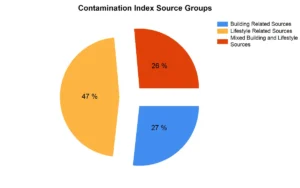
The report itself explains that its Contamination Index categories are estimates and may not represent every VOC present in the air sample. It also states that the concentrations within the categories are approximate and may not add up to the overall TVOC measurement.
That is why VOC results should be interpreted within the context of the property, sampling location, building history, recent activities, ventilation, products used or stored, and other environmental conditions.
At Quest Environmental Testing, our role is to provide environmental testing and objective information about indoor conditions. We do not rely on assumptions about what may be present. Laboratory-based environmental testing can help provide a clearer picture of the compounds detected in an indoor air sample and help identify areas that may warrant further investigation.
Also Read: Penicillium Mold Allergy and Indoor Exposure
Improving Indoor Air Quality Starts With Understanding the Source
The report emphasizes that locating and removing the source of a chemical compound is one of the most effective ways to reduce its concentration. It also notes that increasing outdoor air, filtration, or air purification may help reduce TVOC levels, although VOCs can continue to off-gas from sources over time.
This is why testing can be an important first step.
Rather than guessing whether a chemical odor is coming from paint, cleaning products, personal-care products, adhesives, fuels, or another source, professional VOC testing can provide data to help guide the investigation.
Understand Your Indoor Air With Quest Environmental Testing
VOCs are often invisible, and their sources are not always obvious. A home can appear clean while still containing measurable chemical compounds in the indoor air.
VOC testing provides a way to look beyond what can be seen. By analyzing indoor air and identifying individual compounds and potential source categories, environmental testing can provide valuable information for homeowners, property owners, building managers, and others concerned about indoor air quality.
At Quest Environmental Testing, we provide independent environmental testing to help clients better understand potential indoor environmental concerns. If you are experiencing persistent chemical odors, have recently renovated a property, or want objective information about indoor air quality, professional VOC testing can be an important part of the investigation.
Test the air. Identify potential sources. Make informed decisions about your indoor environment.
Quest Environmental Testing
Independent Environmental Testing & Indoor Air Quality Services
Serving New York and surrounding areas.