
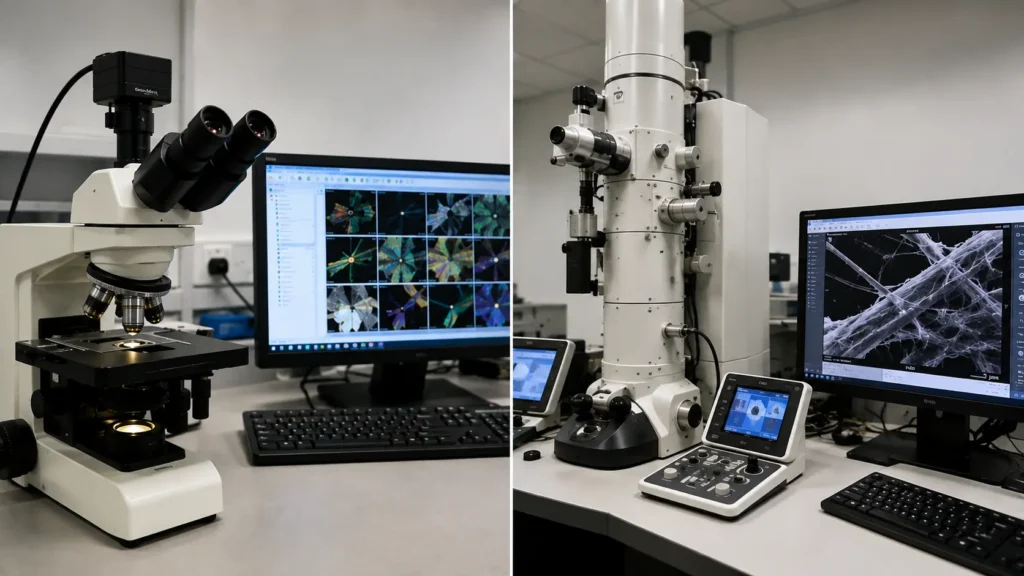
An asbestos inspector collects a sample from old floor tile, plaster, insulation, or another suspect material, but collecting it is only half of the testing process. The laboratory still needs an analytical method to determine whether asbestos is present.
Two methods you may see on asbestos reports are PLM and TEM. Understanding PLM vs TEM asbestos testing matters because they do not perform exactly the same job. PLM, or Polarized Light Microscopy, is widely used to analyze bulk building materials. TEM, or Transmission Electron Microscopy, has specific uses where the material or testing requirement calls for another level of analysis.
For asbestos testing in NYC, the appropriate method depends on the material sampled, its composition, the type of sample, and the New York State laboratory method that applies. Quest’s current service information confirms that asbestos samples are collected and sent to independent accredited laboratories for analysis.
What Is PLM Asbestos Testing?
PLM asbestos testing stands for Polarized Light Microscopy.
It is a laboratory method used to identify asbestos in bulk building materials. A laboratory analyst prepares part of the submitted material and examines its optical characteristics under a microscope equipped with polarized light.
New York State Department of Health identifies NYS DOH ELAP Item 198.1 as its Polarized Light Microscopy method for asbestos in bulk materials. The state also has Item 198.6, a PLM method specifically for certain non-friable organically bound materials.
Bulk materials commonly associated with asbestos testing can include:
- Plaster
- Joint compound
- Ceiling materials
- Pipe insulation
- Thermal insulation
- Floor tile
- Roofing products
- Cement products
- Adhesives and mastics
- Other suspect building materials
The laboratory method is selected according to what the material actually is rather than simply using one test for every sample.
What Is TEM Asbestos Testing?
TEM asbestos testing stands for Transmission Electron Microscopy.
Instead of examining a sample with polarized visible light, TEM uses an electron microscope.
In New York, TEM is not simply a premium version of PLM that replaces it for every sample. NYS Department of Health lists ELAP Item 198.4 specifically for analyzing asbestos in non-friable, organically bound bulk materials by TEM. The state also recognizes TEM methods for asbestos air analysis.
That distinction matters.
A TEM laboratory analysis may be appropriate because of the type of material, the result obtained through another approved method, or the regulatory testing procedure being followed.
The person ordering laboratory analysis should therefore know what material was sampled and why that analytical method applies.
PLM vs TEM Asbestos Testing: What Is the Main Difference?
The simplest PLM vs TEM asbestos testing comparison is this:
| Method | Main Use | How the Sample Is Examined |
| PLM | Common bulk building-material asbestos analysis | Polarized light microscopy |
| PLM for NOB material | Certain non-friable organically bound bulk materials | Specialized preparation followed by PLM |
| TEM for NOB material | Certain non-friable organically bound bulk samples | Transmission electron microscopy |
| TEM air analysis | Certain asbestos air-testing applications | Transmission electron microscopy |
New York’s laboratory program maintains separate methods because the composition of the sample affects how asbestos fibers can be identified.
This is why a report may show PLM for one building material and TEM for another material collected from the same property.
The difference does not automatically mean one sample was tested more carefully.
It means different analytical methods were used for different testing needs.
Read More: What Is an ACP5 Inspection and Why Does NYC Require It?
Why Is PLM Commonly Used for Bulk Asbestos Samples?
PLM is established specifically for identifying asbestos in bulk building materials.
A bulk sample means that an inspector removes a small physical piece of the suspect material and submits it for laboratory analysis.
For example, an inspector preparing an Asbestos Testing in NYC survey may collect samples from ceiling plaster, pipe insulation, wall material, or another material that could be disturbed during planned construction.
The laboratory can then use the applicable PLM method to identify whether asbestos is present.
Bulk asbestos sampling involves collecting a small physical sample from a suspect building material and sending it to an accredited laboratory for analysis. Its laboratory information also identifies polarized light microscopy as the standard analysis used for many bulk building materials.
PLM therefore remains central to pre-renovation asbestos investigation.
What Does Non-Friable Organically Bound Material Mean?
The phrase non-friable organically bound, often shortened to NOB, is important when comparing PLM and TEM.
These materials contain a binder or matrix that holds the components together. Certain resilient flooring products and related materials are common examples.
New York maintains separate analytical methods for NOB materials because identifying asbestos inside this type of matrix can require additional sample preparation.
The state lists:
ELAP 198.6: asbestos in non-friable organically bound bulk samples by PLM.
ELAP 198.4: asbestos in non-friable organically bound bulk samples by TEM. (New York State Department of Health)
This is one reason floor-related samples can create more complicated laboratory reports than a simple piece of friable insulation.
The laboratory must analyze the material using the method appropriate to that sample type.
Why Can Floor Tile and Mastic Need Different Asbestos Analysis?
A floor can contain several materials even though the homeowner sees one finished surface.
There may be:
- Vinyl or resilient tile
- Sheet flooring
- Backing
- Black mastic
- Another adhesive
- Leveling material
- Older flooring underneath
Each material can have a different asbestos result.
A negative result from the tile should not automatically be applied to adhesive underneath it.
The inspector first identifies the separate suspect materials and collects representative bulk samples. The laboratory then determines which approved analytical procedure applies.
This is where PLM vs TEM asbestos testing becomes a practical project issue rather than just a laboratory term.
If the flooring is classified as a non-friable organically bound material, the NOB analytical methods can become relevant.
Does a Negative PLM Result Always Mean TEM Is Required?
No.
A negative PLM result does not automatically mean every sample must receive TEM analysis.
The next step depends on the material and analytical method used.
For an ordinary bulk material analyzed through the appropriate PLM method, a laboratory result may complete the required analysis.
Certain NOB materials require a different decision process because New York has specific PLM and TEM methods for that category.
This is why homeowners and contractors should avoid reading a laboratory report as:
“PLM negative means test again with TEM.”
That is too broad.
The correct question is:
Which ELAP method applies to this material and project?
The accredited laboratory and qualified asbestos professional use the material classification and applicable regulations to answer that question.
Is TEM More Accurate Than PLM?
TEM can resolve structures that are too small for ordinary optical microscopy, which is one reason it has specialized asbestos applications.
However, calling TEM simply “more accurate” creates the wrong impression.
Accuracy depends on whether the correct test has been chosen for the material and purpose.
PLM is an accepted method specifically intended for bulk asbestos analysis. TEM is required or useful in other defined situations.
A PLM result obtained through the correct approved method is not an inferior test simply because an electron microscope was not used.
For property owners, the better question is not “Which microscope is stronger?”
It is “Which approved asbestos analytical method applies to the sample?”
PLM vs TEM for Asbestos Air Testing Is a Different Comparison
Bulk testing and air testing should not be mixed together.
PLM is primarily associated with physical bulk building-material samples.
TEM also has applications in asbestos air analysis.
New York State Department of Health lists an interim TEM analytical method for airborne asbestos and explains that TEM air analysis is typically required in K-12 schools after certain asbestos abatement projects for final reoccupancy criteria.
That is a different purpose from testing a piece of floor tile.
An air sample asks whether asbestos structures are present in collected airborne material.
A bulk sample asks whether the building material itself contains asbestos.
When reviewing a laboratory report, first check whether you are looking at a bulk asbestos result or an air-monitoring result.
How Does Asbestos Testing in NYC Fit Into Renovation Planning?
For NYC renovation and demolition work, asbestos investigation happens before suspect materials are disturbed.
The New York City Department of Environmental Protection states that building owners are responsible for having an asbestos survey performed by a DEP-certified asbestos investigator when asbestos-containing materials may be disturbed during building work. Laboratories analyzing asbestos samples must have appropriate Environmental Laboratory Approval Program accreditation through New York State.
That means the process has several separate steps:
- The planned construction scope is reviewed.
- Suspect building materials are identified.
- Representative samples are collected by the appropriate professional.
- Samples are submitted to an accredited laboratory.
- The laboratory applies the correct analytical method.
- Results are incorporated into the project documentation.
The microscope is only one part of a larger compliance process.
Why Does ELAP Laboratory Accreditation Matter for PLM and TEM?
New York does not treat any laboratory with a microscope as qualified to issue asbestos results for regulated environmental testing.
NYC DEP states that laboratories must hold accreditation through the New York State Department of Health’s Environmental Laboratory Approval Program, or ELAP.
The laboratory also needs accreditation for the appropriate asbestos analytical category.
This matters because PLM and TEM involve different methods.
A laboratory’s ability to perform one asbestos method should not simply be assumed to mean it holds approval for every asbestos method.
After collection, asbestos samples are sent to a qualified laboratory for analysis using the method appropriate for the material and testing purpose.
Also Read: How Much Does Asbestos Testing Cost in NYC?
Can Property Owners Choose PLM or TEM Themselves?
Usually, selecting the method should not start with the homeowner choosing a microscope from a menu.
The material and purpose of testing come first.
If you are planning to remove an old floor, for example, the useful information is the age, material layers, scope of demolition, and condition of the flooring.
The inspector identifies the suspect materials.
The laboratory then follows the analytical method appropriate for those samples and regulatory requirements.
Requesting TEM for every material can add unnecessary analysis without improving a project that properly calls for PLM.
Requesting only basic PLM when another method is required can create the opposite problem.
Professional Asbestos Testing in NYC should match the laboratory method to the material rather than starting with the most familiar acronym.
Read PLM and TEM Results Before Construction Disturbs the Material
PLM and TEM are both important asbestos laboratory tools, but they are used for different purposes. PLM is central to bulk building-material analysis. New York also has a dedicated PLM procedure for non-friable organically bound materials, while TEM has its own approved NOB method and roles in asbestos air analysis. The right choice depends on the sample, not on which microscope sounds more advanced.
Quest Mold and Asbestos Inspections and Testing provides independent asbestos inspection and testing for residential, commercial, school, and other properties across all five NYC boroughs and Long Island. Its current services include asbestos inspection, bulk sampling, air testing, air monitoring, clearance testing, and accredited independent laboratory analysis, while the company states that it performs testing and inspection rather than remediation.
If you need Asbestos Testing in NYC before renovation, demolition, or another project that may disturb suspect material, contact Quest Mold and Asbestos Inspections and Testing so the material can be sampled and sent for the analytical method that applies to the project.