

When people hear “VOC testing,” they may picture an environmental inspector walking through a property with a handheld meter. While handheld instruments are useful, professional VOC and chemical air testing can involve several different types of equipment and sampling methods, depending on the specific VOC, chemical, gas, odor, or contaminant being investigated.
At Quest Mold & Asbestos Inspections & Testing, the testing approach is selected based on the concern at the property. Some equipment is used in the field for immediate screening, while other equipment is used to collect air samples that are submitted to an accredited laboratory for analysis.
There is no single meter or sampling device that can identify every VOC, gas, or chemical in indoor air. The equipment, sampling method, and laboratory analysis should be selected based on what contaminant is being investigated and what information is needed from the testing.
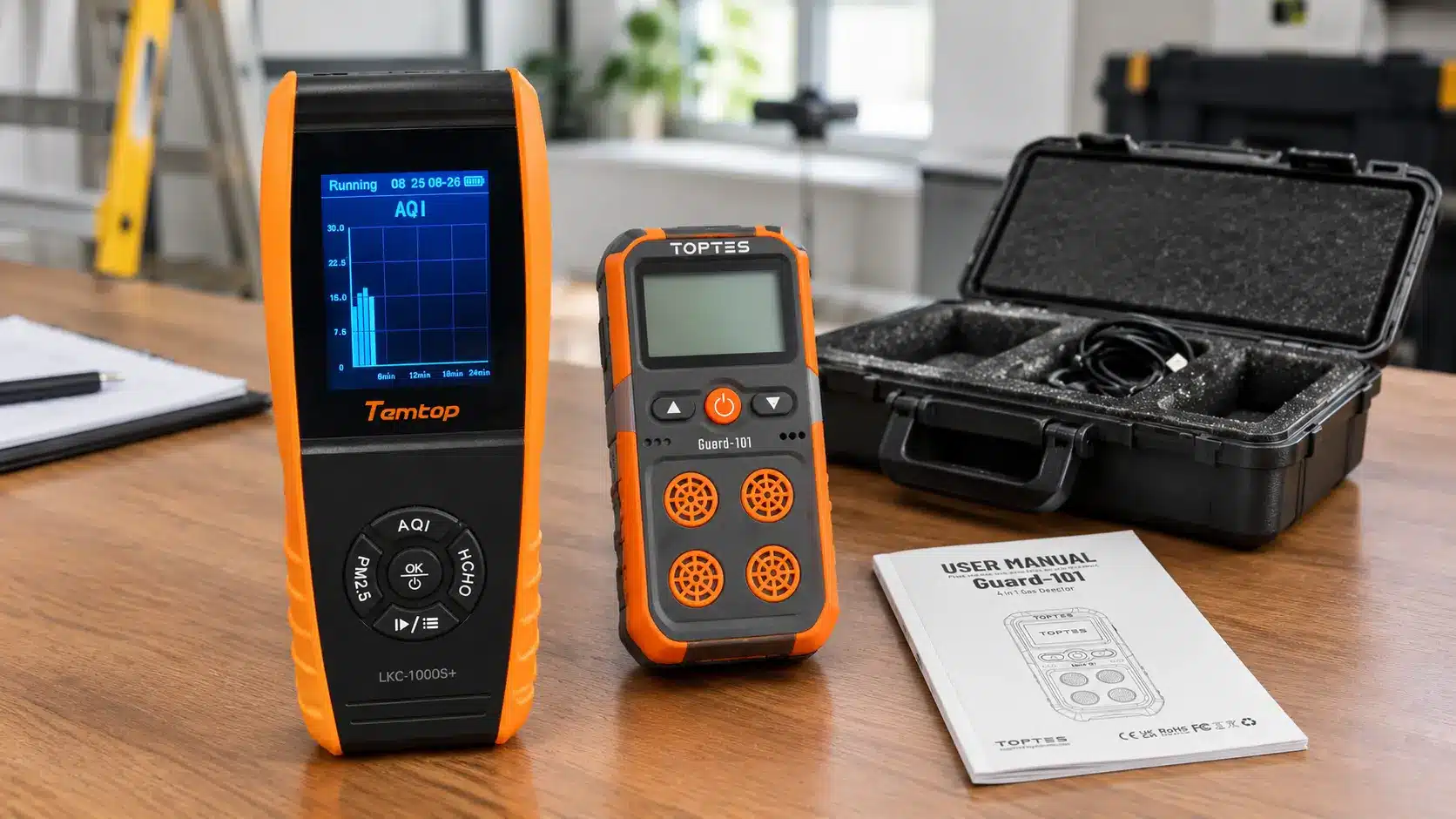
1. Handheld Photoionization Detector (PID) – Real-Time VOC Screening
A Photoionization Detector (PID) is a handheld meter used for real-time VOC screening during an environmental inspection.
The handheld PID provides an immediate indication of overall VOC levels in the air. It can be used to compare different rooms or areas, identify locations with higher readings, investigate potential sources, and help determine whether additional sampling may be appropriate.
The main advantage of the PID is that it provides immediate, on-site readings. However, it should generally be considered a screening instrument. A PID typically does not identify exactly which individual VOC compounds are responsible for the reading.
At Quest, PID screening is performed in-house as part of the field investigation and does not include accredited laboratory analysis or a laboratory report.
When the objective is to identify and measure specific VOC compounds, air samples can be collected and submitted to the laboratory for more detailed analysis.
In simple terms, the handheld PID helps screen for VOC activity, while laboratory testing can provide more detailed, compound-specific information.
2. SUMMA Canister – Whole-Air VOC Sampling
A SUMMA canister is a specially prepared stainless-steel air-sampling device used to collect an actual sample of indoor air for laboratory analysis.
Unlike a handheld PID, the SUMMA canister does not simply provide an immediate reading. Instead, it collects a whole-air sample from the property. After sampling is completed, the canister is submitted to the laboratory.
For detailed VOC testing, the laboratory may analyze the sample using EPA Method TO-15, which uses Gas Chromatography/Mass Spectrometry (GC/MS). The laboratory analyzes the sample for the VOCs included in the selected target list and reports detected concentrations.
Depending on the laboratory panel selected, testing may include compounds such as benzene, toluene, ethylbenzene, xylenes, and many other VOCs.
SUMMA canister sampling is therefore useful when the objective is to obtain compound-specific laboratory information, rather than only a general VOC screening reading.
3. Sorbent & Charcoal Tubes – Targeted Chemical Sampling
Sorbent tubes and charcoal tubes are specialized air-sampling devices used to capture selected VOCs or other chemicals for laboratory analysis.
With this type of sampling, air is pulled through the appropriate tube using a calibrated sampling pump. The sampling media inside the tube captures certain compounds from the air.
After collection, the tube is sealed and submitted to the laboratory for analysis.
For appropriate VOC applications, EPA Method TO-17 describes active sampling of VOCs onto sorbent tubes followed by thermal desorption and gas chromatographic analysis.
Different sampling media can be selected depending on the chemicals being investigated. This is another reason professional VOC and chemical testing is not simply a matter of using one meter for every situation.
4. Calibrated Air-Sampling Pump – Controlled Sample Collection
A calibrated air-sampling pump is field equipment used with sorbent tubes, charcoal tubes, and other active sampling media.
The pump pulls a controlled amount of air through the selected sampling media at a specified flow rate for a predetermined period of time.
The flow rate, sampling duration, and total volume of air collected are important because this information may be used by the laboratory when determining concentrations.
The sampling pump itself does not identify chemicals. Its purpose is to help ensure that the air sample is collected properly and consistently before it is submitted to the laboratory.
5. TOPTES 4-Gas Handheld Meter – Real-Time Gas Screening
The TOPTES 4-Gas Meter is a handheld field instrument used for real-time screening of multiple gases during an indoor air quality, odor, or environmental investigation.
Depending on the specific model and sensor configuration, a 4-gas meter may measure gases or parameters such as hydrogen sulfide (H₂S), carbon monoxide (CO), oxygen (O₂), and combustible gases (LEL).
For investigations involving sulfur, sewer-like, or rotten-egg odors, the hydrogen sulfide sensor can be particularly useful. It allows the inspector to take immediate readings in different areas of the property and evaluate whether the meter detects H₂S at the time of the inspection.
The TOPTES 4-Gas Meter is an in-house field screening instrument. Like the PID, it provides immediate on-site information and does not include accredited laboratory analysis or a laboratory report.
When more detailed identification or documentation of hydrogen sulfide or other sulfur compounds is needed, an air sample can be collected for laboratory analysis.
Read More: What Is VOC Testing? How Indoor Air Testing Can Identify Hidden Chemical Sources
6. SUMMA Canister – Hydrogen Sulfide & Sulfur Gas Laboratory Testing
A SUMMA canister can also be used to collect an air sample for specialized hydrogen sulfide and sulfur-gas laboratory analysis.
This provides a different level of information than the handheld 4-gas meter. The handheld meter can provide immediate H₂S screening in the field, while SUMMA sampling allows an actual air sample to be submitted to the laboratory for more detailed analysis.
The available laboratory testing information includes hydrogen sulfide testing using ASTM D5504 with SUMMA sampling.
Depending on the selected laboratory analysis, sulfur-gas testing may include:
- Hydrogen sulfide (H₂S)
- Carbon disulfide
- Methyl mercaptan
- Ethyl mercaptan
- Dimethyl sulfide
This type of laboratory testing can be useful when investigating persistent sulfur, rotten-egg, sewer-like, or other unusual odors.
In simple terms, the TOPTES 4-Gas handheld meter can provide immediate H₂S screening, while SUMMA canister sampling with laboratory analysis can provide more detailed information about selected sulfur gases.
7. Dräger X-act 7000 – Targeted Chemical & Gas Testing
The Dräger X-act 7000 is specialized equipment used by the laboratory for targeted testing of certain chemicals and gases.
According to the available laboratory testing information, the Dräger X-act 7000 may be used for testing involving formaldehyde, ammonia, and carbon dioxide (CO₂).
This type of testing is different from general VOC screening with a handheld PID. When the concern is a specific chemical or gas, the laboratory can use equipment and an analytical approach directed toward that particular contaminant.
For example, when the concern is specifically formaldehyde or ammonia, targeted testing can be selected rather than interpreting a general VOC meter reading as a measurement of those individual chemicals.
The laboratory information also identifies the Dräger X-act 7000 for carbon dioxide testing. Carbon dioxide is not a VOC, but it can be an important indoor-air parameter.
This demonstrates why professional indoor-air investigations may require different equipment for different chemicals and gases.
8. Thermal Desorption Equipment – Laboratory Sample Preparation
Thermal desorption equipment is specialized laboratory equipment used with certain sorbent-tube samples.
After a collected sorbent tube reaches the laboratory, thermal desorption can be used to remove the captured compounds from the sampling material. Those compounds can then be transferred into analytical equipment for separation, identification, and measurement.
EPA TO-17 specifically describes the sorbent-tube, thermal-desorption, and gas-chromatographic approach.
Thermal desorption is part of the laboratory analytical process and should not be confused with the equipment used by the environmental inspector to collect the sample at the property.
9. GC/MS – Laboratory Equipment for VOC Identification
Gas Chromatography-Mass Spectrometry (GC/MS) is sophisticated laboratory analytical equipment used for detailed chemical analysis.
Gas chromatography separates individual compounds within a sample, while mass spectrometry helps identify those compounds based on their characteristics.
For example, EPA TO-15 uses GC/MS for the analysis of VOCs collected in specially prepared canisters. TO-17 can also include GC/MS analysis following sorbent-tube sampling and thermal desorption.
This is very different from receiving a general reading from a handheld VOC meter. Depending on the analytical method and target list selected, laboratory analysis can provide compound-specific identification and measured concentrations.
Also Read: Formaldehyde in Indoor Air and the Importance of Professional Testing
Field Equipment vs Laboratory Equipment
An important part of understanding professional VOC and chemical testing is knowing the difference between field equipment and laboratory equipment.
Field equipment is used at the property for screening or collecting samples. Depending on the investigation, this may include a handheld PID meter, TOPTES 4-Gas Meter, SUMMA canisters, sorbent or charcoal tubes, and calibrated air-sampling pumps.
Some field instruments, such as the PID and TOPTES 4-Gas Meter, provide immediate readings but do not include an accredited laboratory report.
Other equipment, such as SUMMA canisters and sampling tubes, is used to collect an actual air sample. Those samples are then submitted to the laboratory.
The laboratory performs the requested analysis using the appropriate analytical methods and specialized equipment. This may include GC/MS, thermal desorption systems, the Dräger X-act 7000 where specified by the laboratory method, and other specialized analytical instrumentation.
This distinction is important because field screening, professional sample collection, and laboratory analysis are different parts of an environmental investigation.
Why Different Chemicals Require Different Equipment
There is no single instrument that can properly test for every indoor-air contaminant.
For example, a handheld PID may be appropriate for general VOC screening, but it typically cannot tell you which individual VOC is causing the reading.
A TOPTES 4-Gas Meter can provide immediate field screening for gases such as hydrogen sulfide when equipped with the appropriate sensor, but it does not replace detailed laboratory analysis.
A SUMMA canister can collect a whole-air sample for laboratory analysis. Depending on the selected method, this can be used for detailed VOC testing or targeted sulfur-gas testing.
Sorbent and charcoal tubes with calibrated sampling pumps provide another way to collect samples for targeted laboratory analysis.
For certain specific chemicals and gases, such as formaldehyde, ammonia, and carbon dioxide, the laboratory may use specialized equipment such as the Dräger X-act 7000, according to the selected testing method.
The appropriate equipment should therefore be selected based on what is suspected, what needs to be measured, and what information the client needs from the investigation.
Why Professional Sampling Matters
Professional VOC and chemical air testing involves more than simply turning on a meter and taking a reading.
The sampling location, sampling duration, equipment, flow rate, total air volume, sampling media, handling, storage, transportation, and laboratory analytical method can all affect the quality and usefulness of the results.
For this reason, selecting the proper equipment and sampling method is an important part of an environmental investigation.
A handheld meter may be useful for immediate field screening, while properly collected samples and laboratory analysis may be needed when the objective is to identify and measure specific VOCs, chemicals, or gases.
Professional VOC & Chemical Air Testing
At Quest Mold & Asbestos Inspections & Testing Corp., we focus on selecting the appropriate field screening and sampling approach based on the specific environmental concern.
Depending on the investigation, field equipment may include handheld PID screening, TOPTES 4-Gas screening, SUMMA canister sampling, sorbent or charcoal tube sampling, and calibrated air-sampling pumps.
When laboratory analysis is required, properly collected samples are submitted to the laboratory, where the appropriate analytical method and specialized laboratory equipment are used.
The goal is not simply to provide a number from a handheld device. The goal is to select the appropriate equipment, sampling method, and laboratory analysis based on the specific VOC, chemical, gas, or odor concern being investigated.
For concerns involving VOCs, unusual chemical odors, formaldehyde, ammonia, hydrogen sulfide, sulfur gases, hydrocarbons, carbon dioxide, or other potential indoor-air contaminants, contact Quest Environmental Testing to discuss the appropriate testing approach for your property.