Air Quality Mold Testing – Why It’s Needed and How It Works
Indoor air quality plays an important role in the health, comfort, and safety of your home or business and those occupying it. Without it you are not actually aware of what is going on behind and underneath the surfaces. Many property owners wrongly assume that mold is only a problem when you can physically see it, but the truth is that mold contamination often starts in the air before it appears on surfaces. Mold spores in the air can spread quickly, affect sensitive individuals, and settle on building materials. Eventually creating larger mold growths that spread throughout the space. Potentially risking the integrity of your property and your health.
As a licensed and certified inspection company, Quest Environmental Testing uses new advanced equipment, moisture detection tools, and accredited laboratories to determine whether your property has elevated mold levels and what type of mold is present in the air you are breathing.
This guide explains why air quality mold testing matters, the different testing methods, and what your lab results mean, so you can make safe and informed decisions for your property and your health. At Quest we take pride in our dedication to help our clients breathe cleaner air.
Why Air Quality Testing for Mold Is Important
1. Mold Is Often Not Visible
Many harmful molds (including Aspergillus Penicillium and even Stachybotrys also known as Black Mold) begin as microscopic spores floating in the air. Eventually settling on materials to grow and reproduce.
You may experience some of these symptoms without seeing any visible growth:
- Musty odors
- Allergies
- Respiratory irritation
- Headaches
- Fatigue
- Sinus issues
- Chronic coughing
- Irritated eyes or skin
Air testing helps detect hidden mold sources behind walls, in ceilings, HVAC systems, or under flooring. Also confirming if your symptoms are from breathing mold spores.
2. Air Samples Show How Serious the Problem Might Be
A professional mold air test measures:
- Spore concentration (how many mold spores per cubic meter)
- Spore types (Cladosporium, Aspergillus/Penicillium, Basidiospores, Stachybotrys, etc.)
- Indoor vs. outdoor comparison
- Elevated vs. normal levels
This is important because visible mold alone cannot tell you how contaminated the air is or what kinds of mold are there.
3. Lab Results Provide Scientific Evidence
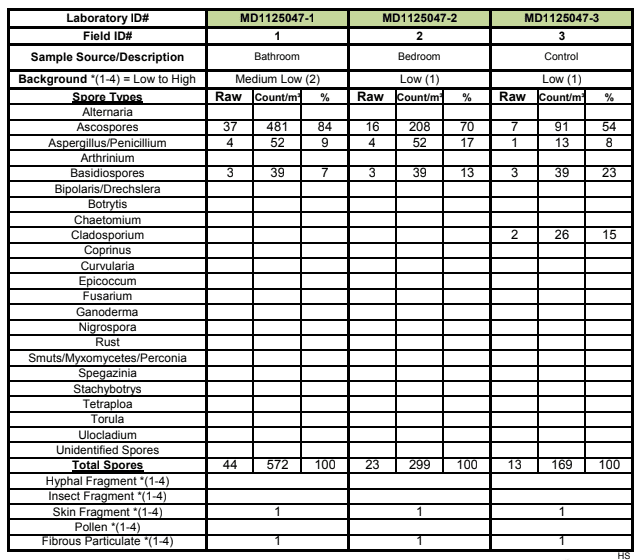
Air samples are analyzed by a certified, accredited laboratory, which generates a detailed spore report.
Reports typically show:
- Spore types identified
- Spore counts per cubic meter
- Total air spore concentration
These results help determine if remediation is needed.
Different Testing Methods: What are they and what is the difference?
Customers often ask why inspectors choose one method over another.
Each method serves a different purpose and give us different answers:
1. Air Quality Mold Testing (Spore Trap Air Samples)
Purpose: Detect airborne mold spores, hidden mold, HVAC contamination, and overall indoor air quality.
How It Works:
A high-precision air pump collects a controlled volume of air through a spore trap cassette. The cassette is sealed, labeled (chain of custody), and analyzed by an accredited lab.
When to Use:
- Musty odors
- No visible mold
- Allergic symptoms
- Suspected hidden mold
- Pre-remediation and post-remediation clearance
- Real estate transactions
- Basements, attics, HVAC systems
Advantages:
- Shows true air contamination levels
- Identifies types and concentrations
- Helps locate hidden mold sources
- Scientifically measured by a lab
Air testing is often the most important test for determining indoor mold exposure risk because this is what you are actively breathing in.
2. Tape-Lift Mold Sampling
Purpose: Identify surface mold that is visible or suspected on drywall, wood, furniture, insulation, or dust.
How It Works:
Clear adhesive tape or a specialized cassette is gently pressed onto the surface to capture spores and structures.
When to Use:
- Visible spots or discoloration
- Suspected growth on walls or ceilings
- Determining whether a stain is mold, dirt, or soot
Advantages:
- Excellent for identifying the type of mold
- Non-destructive
- Quick results
Limitations:
Tape-lift does not measure airborne mold levels or overall air quality.
3. Swab Mold Testing
Purpose: Identify mold on porous or irregular surfaces—textured walls, carpets, insulation, HVAC grilles.
How It Works:
A sterile swab is rubbed on the surface and sent to the lab.
When to Use:
- Sticky or wet material
- Deep cavities in building materials
- HVAC vents
- Biofilm or thick mold layers
Limitations:
Swabs identify what mold is present, but they do not measure the level of spores in the air.
Why Most Homes Need Air Testing and Not Just Surface Testing
Surface testing (tape or swab) only tells you what’s growing on one spot.
Air testing tells you:
- Is the mold affecting the air you breathe?
- How serious is the contamination?
- Is mold spreading from a hidden source?
- Is the HVAC distributing spores?
- Is remediation working or complete (before & after)?
For complete accuracy, Quest Environmental Testing often combines:
- Air samples (most important)
- Tape or swab (to confirm surface growth)
- Infrared scanning
- Moisture mapping
- Visual inspection
This ensures the property is evaluated from every angle to ensure if there are hidden issues they will be uncovered.
At Quest Environmental Testing, we are licensed, insured, and certified mold assessors serving New York City and Long Island.
We use professional air sampling equipment, infrared moisture scanning, and accredited laboratory analysis to ensure accurate, reliable results.
If you suspect mold, experience odors, or want peace of mind, air quality testing is the most effective way to understand what is in the air you’re breathing.
For inspections, testing, and lab analysis, contact Quest Environmental Testing.